
Comparing two routes
Express Entry vs Francophone Mobility: which route fits you?
Express Entry is a selection system for permanent residence, open to a profile without a prior job offer. Francophone Mobility is a work permit tied to a specific employer, reserved for French speakers targeting a role outside Quebec. These are two different mechanisms, and they can also be combined.
Updated

Two different mechanisms, not two versions of the same thing
Express Entry is a federal selection system for permanent residence. A candidate creates a profile, that profile is assessed against several factors (age, education, experience, knowledge of French and English, among others), and the highest-ranked profiles receive an invitation to apply for permanent residence. A job offer is not required to enter the system; any role it plays depends on the criteria in effect, which should be checked on the official IRCC website.
Francophone Mobility, also called the C-16 stream, is a temporary work-permit mechanism. It allows an employer located outside Quebec to hire a French-speaking worker without a Labour Market Impact Assessment, under conditions set by IRCC. It always assumes a specific employer has already offered a role: without an offer, there is no Francophone Mobility file.
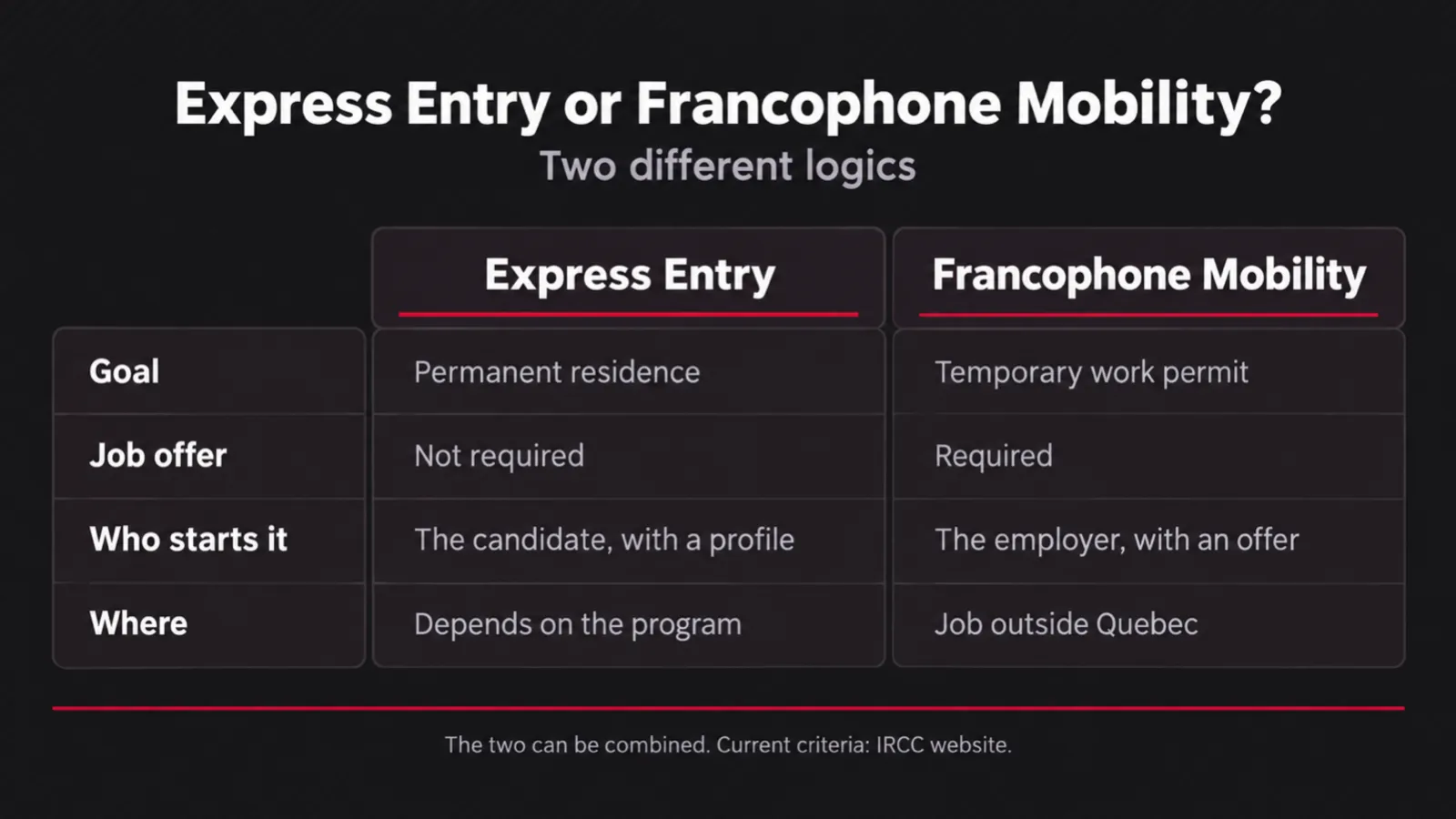
At a glance:
- Goal: permanent residence (Express Entry); a temporary work permit (Francophone Mobility)
- Job offer: not required (Express Entry); required (Francophone Mobility)
- Who starts the process: the candidate, by creating a profile (Express Entry); the employer, through its offer (Francophone Mobility)
- Quebec: Francophone Mobility covers roles outside Quebec; Quebec applies its own selection rules
Who each route fits
Express Entry suits a profile aiming to settle in Canada long-term, with or without a job offer in hand, whose background (education, experience, languages) is strong against the federal criteria. It targets permanent residence directly.
Francophone Mobility suits a French-speaking candidate who already has, or is close to obtaining, a concrete job offer from a Canadian employer located outside Quebec. It is a temporary work route, more direct to start because it relies on an existing offer rather than a ranking among other profiles.
The role of a job offer in each route
In Express Entry, a Canadian job offer is not a condition of entry into the system; any role it plays depends on the criteria in effect at the time of application, published on the official IRCC website.
In Francophone Mobility, the job offer is the starting point: it is what makes the work-permit application possible, and it is the employer, through that offer, who triggers the process. A candidate without an offer cannot open a Francophone Mobility file.

The two routes can be combined
A possible path is to first secure a work permit through Francophone Mobility, to settle in Canada and work there, while building or submitting an Express Entry profile in parallel to aim for permanent residence. Canadian work experience gained this way can, depending on the criteria in effect, have an effect on an Express Entry profile — the exact criteria change regularly and should be checked on the official IRCC website at the time of the application.
Conversely, a candidate already accepted for permanent residence through Express Entry does not need a separate temporary work permit to work in Canada once they become a permanent resident.
What NorthBridge Talent does on these two files
NorthBridge Talent is a recruitment agency based in Casablanca. We connect Moroccan candidates with verified Canadian employers — particularly useful for a Francophone Mobility file, which needs a real offer.
We never file immigration applications and never give immigration legal advice, whether for Express Entry or Francophone Mobility: that work is carried out by partner Canadian and British immigration experts, to whom we hand a file prepared with you.
Frequently asked questions
What is the main difference between Express Entry and Francophone Mobility?
Express Entry is a selection system for permanent residence, with no job offer required to start. Francophone Mobility is a temporary work permit tied to a specific offer from an employer located outside Quebec.
Do I need a job offer to enter the Express Entry system?
No, an offer is not required to create a profile. Any role it plays depends on the criteria in effect, which should be checked on the official IRCC website.
Which of the two routes leads to permanent residence?
Express Entry leads to it directly: it is a selection system for permanent residence. Francophone Mobility does not; it opens a temporary work permit tied to an employer. Canadian work experience gained on that permit can then count towards an Express Entry profile, depending on the criteria in effect at the time of the application.
Can Express Entry and Francophone Mobility be combined?
Yes, this is a possible path: Francophone Mobility lets you work in Canada on a concrete offer, while an Express Entry profile is built or submitted in parallel to aim for permanent residence.
Is Francophone Mobility limited to Quebec?
The opposite: it applies to roles located outside Quebec, for French-speaking candidates. Quebec applies its own immigration selection rules.
Can NorthBridge Talent file my Express Entry or Francophone Mobility application?
No, NorthBridge Talent never files immigration applications and never gives immigration legal advice. We connect you with verified employers and prepare the file with you, then partner Canadian and British immigration experts handle the filing.
LET’S TALK ABOUT YOUR PLANS
An adviser answers you, in Casablanca or remotely
Ask your question, have your file reviewed or book a consultation. You receive a written quote before any payment.
Monday to Friday, 9 am to 5 pm