
The French test used in Canadian applications
TCF Canada from Morocco: what the exam is for and how to prepare
The TCF Canada is the Test de connaissance du français, designed by France Éducation international for Canadian immigration applications. It has four sections: listening comprehension, reading comprehension, writing and speaking. Results are expressed as levels on the Common European Framework of Reference for Languages (CEFR) scale, which IRCC converts to the Niveaux de compétence linguistique canadiens (NCLC), the French-language counterpart of the Canadian Language Benchmarks (CLB).
Updated

What is the TCF Canada, and who designs it?
The Test de connaissance du français (TCF) is a language test designed and administered by France Éducation international, the French public operator attached to the Ministry of National Education. The TCF comes in several versions; the one called TCF Canada is the version intended for Canadian immigration applications.
The TCF Canada measures your general French. It does not test your knowledge of Canada, your trade or your plans: it is a language test, nothing else. Its content, its organisation and its marking are the responsibility of France Éducation international; how the result is then used in an application is IRCC’s.
France Éducation international publishes the framework of the test; it is the approved centre that tells you its session dates, the registration procedure, whether the test is sat on paper or on computer, and the fee. Check that at the source before committing: it is what counts, not what a forum or an intermediary says about it.
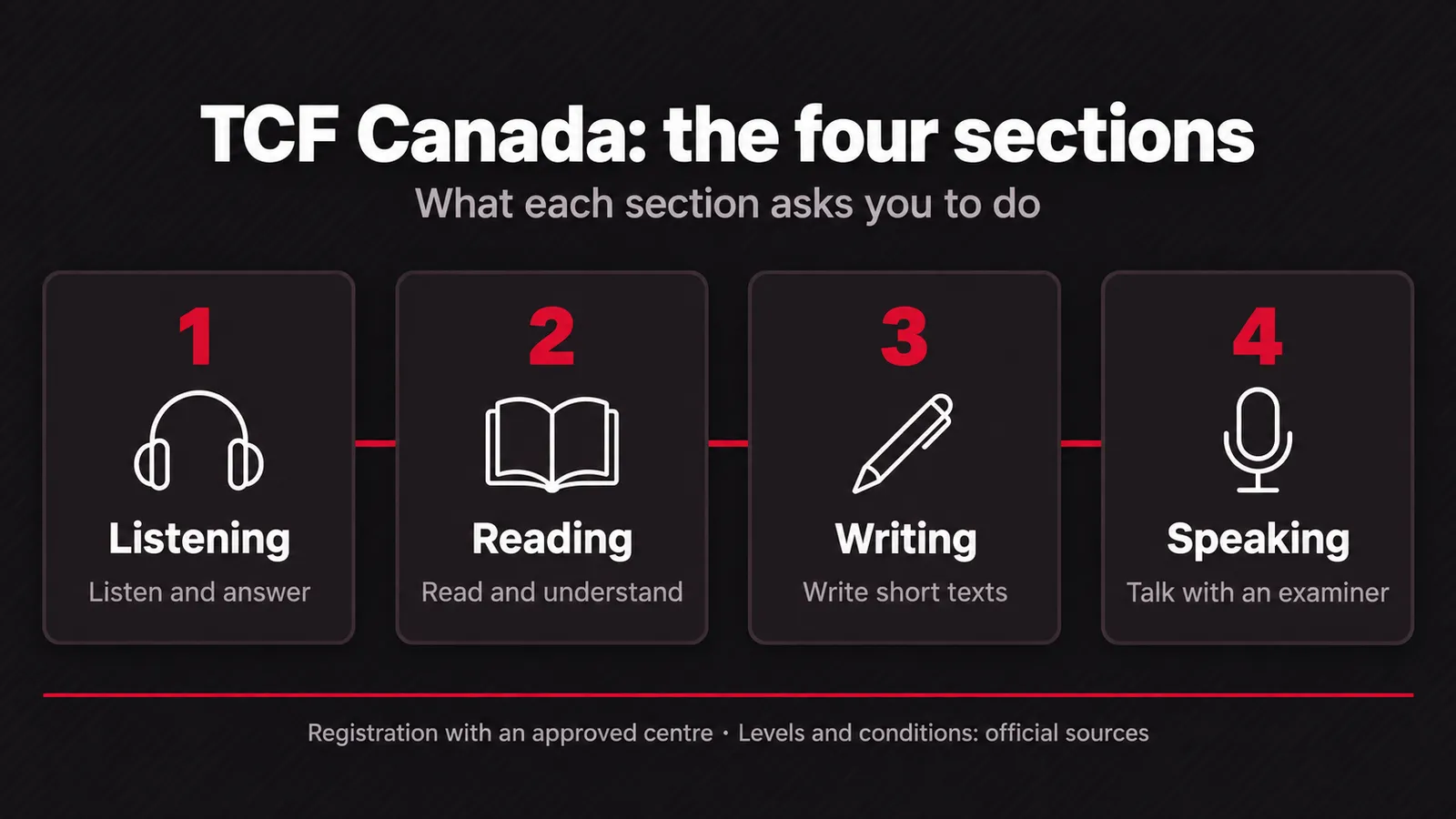
The four sections, and what each one asks
The TCF Canada has four compulsory sections, covering exactly the four abilities IRCC assesses: listening, reading, writing and speaking.
- Listening comprehension: you listen to audio documents — announcements, everyday exchanges, media extracts — and answer multiple-choice questions.
- Reading comprehension: you read written documents — messages, classified ads, articles — and answer multiple-choice questions about what the text actually says.
- Writing: writing tasks of increasing difficulty, from a short practical message to a text where you have to report, compare or argue from source documents.
- Speaking: an individual section, face to face with an examiner, split into tasks: introducing yourself and answering simple questions, obtaining information in a given situation, then expressing and defending a point of view.
Who marks it, and how are results expressed?
The two comprehension sections are multiple choice. The two production sections are assessed by markers and examiners accredited by France Éducation international, against its marking grids. Exactly how the session runs, the number of questions and the length of each section are set out by France Éducation international and by your centre: read them before exam day.
After the test you receive a results certificate giving a result for each of the four sections, expressed as levels on the Common European Framework of Reference for Languages (CEFR) scale — the one running from basic user to proficient user.
IRCC does not use that scale as it is. For Canadian immigration, results are converted to the Niveaux de compétence linguistique canadiens (NCLC), the French-language counterpart of the Canadian Language Benchmarks (CLB). Each ability gets its own level. The conversion tables, the levels each program requires and how long a result is still accepted are set by IRCC and published on its official website. Be wary of any intermediary who quotes you a threshold without showing you the official page.
Where is the TCF Canada used?
The TCF Canada is used wherever IRCC asks for proof of French. In Express Entry, your results in the four sections are converted to NCLC and feed into your profile. For Francophone Mobility (C-16), IRCC assesses spoken French and accepts speaking and listening results from the TCF as well as the TEF.
These are two different routes with different requirements: one is a permanent residence process run through a selection system, the other a work permit that starts with a Canadian employer. Our guides cover each of them.
Express Entry vs Francophone MobilityFrancophone Mobility (C-16)
TCF or TEF: how to choose
Both tests are accepted by IRCC for French: the Test d'évaluation de français (TEF Canada), designed by the Chambre de commerce et d'industrie de Paris Île-de-France, and the Test de connaissance du français (TCF Canada), designed by France Éducation international. Neither is looked on more favourably than the other: IRCC converts both to the same scale, the NCLC.
The differences lie elsewhere.
- The awarding body: France Éducation international for the TCF, the Chambre de commerce et d’industrie de Paris Île-de-France for the TEF. Each has its own network of approved centres.
- The format: both assess the same four abilities, but the instructions, the style of the questions and the marking grids differ. Practise on the official sample material for the test you will actually sit.
- The sessions available near you: in practice, the choice is often made first on what the approved centres in your city offer.
- The results scale: each test has its own, and IRCC publishes a conversion table to the NCLC for each.

How to register for the TCF Canada in Morocco
The TCF Canada is sat at a centre approved by France Éducation international. The centre, and only the centre, opens sessions, takes registrations and collects the exam fee.
The official list of approved centres is published by France Éducation international on its website. That list is the only one that counts: in Morocco as anywhere else, check a centre’s name on it before paying anything. Watch for a common confusion: a school that prepares candidates for the TCF is not necessarily a test centre. They are two different jobs, and one address may do only one of them.
- Find a centre on the official list published by France Éducation international
- Check the sessions that centre announces, its registration procedure and whether it runs the test on paper or on computer
- Register directly with the centre and pay the exam fee to the centre
- Bring the identity document required on exam day, as the centre specifies
- Collect your results certificate from the centre
Preparing: what actually costs candidates points
Useful preparation is not about learning answers. It is about putting yourself in real exam conditions early enough that you are not discovering them on the day.
Speaking is the section where form counts most. Speaking French comfortably day to day is not enough on its own: points are lost on the format of the section, not on the language.
- Treating the interview as an open-ended chat: each task has a precise instruction, and the examiner expects it to be followed.
- Getting the role wrong in the information task: you are expected to ask the examiner real questions, not only to answer them.
- Improvising the argument task: state a position, illustrate it with an example, close it. That structure can be practised; it cannot be improvised.
- Mixing registers: verbal tics and switches into dialectal Arabic land badly in a marked section, even when the examiner understands them.
- Practising without a timer: in writing as in speaking, time is part of the exam. Use a timer from the very first sessions.
- Never recording yourself: listening back to your own answers is the most useful feedback you have.
What NorthBridge Talent does, and does not do
NorthBridge Talent is a recruitment agency based in Casablanca. We connect Moroccan candidates with verified Canadian employers and prepare work-permit and visa files alongside specialised partners.
We also offer TCF Canada preparation. We are not a test centre and we run no exam sessions. Registration for the exam is done with an approved test centre; our preparation does not book you a seat. No preparation, ours included, decides your result: what can be worked on is the format of the test and consistent practice. If you want paid preparation, you receive a written quote before any commitment. No payment is asked before this quote.
We never file immigration applications and never give immigration legal advice: that work is carried out by partner Canadian and British immigration experts, including regulated consultants (RCIC) for Canada.
Frequently asked questions
What is the TCF Canada?
It is the version of the Test de connaissance du français intended for Canadian immigration applications. It is designed and administered by France Éducation international, the French public operator attached to the Ministry of National Education. It measures general French across four sections: listening comprehension, reading comprehension, writing and speaking. It does not test your knowledge of Canada or of your trade.
What sections does the TCF Canada contain?
Four compulsory sections. In listening comprehension you listen to audio documents and answer multiple-choice questions. In reading comprehension you read written documents and answer in the same way. In writing you produce texts of increasing difficulty, from a short message to an argued text. In speaking you sit an individual section, face to face with an examiner, split into tasks.
How are TCF Canada results expressed?
Your results certificate gives a result for each of the four sections, expressed as levels on the Common European Framework of Reference for Languages (CEFR) scale. IRCC does not use that scale as it is: it converts results to the Niveaux de compétence linguistique canadiens (NCLC). The conversion tables and the levels each program requires are published on the official IRCC website.
TCF or TEF: which one should I take for Canada?
Both are accepted by IRCC and converted to the same scale, the NCLC. They differ in their awarding body — France Éducation international for the TCF, the Chambre de commerce et d'industrie de Paris Île-de-France for the TEF — in the format of the questions, and in their networks of centres. Choose the one whose format you know and for which a session is reachable in your city.
How do I register for the TCF Canada in Morocco?
You register directly with a centre approved by France Éducation international, which opens the sessions and collects the exam fee. The official list of approved centres is published by France Éducation international on its website: check a centre’s name there before paying anything. A school that prepares candidates for the TCF is not necessarily a test centre.
Is the TCF Canada used for both Express Entry and Francophone Mobility?
Yes, IRCC accepts the TCF as proof of French in both. In Express Entry, results in the four sections are converted to NCLC and feed into your profile. For Francophone Mobility (C-16), IRCC assesses spoken French and accepts speaking and listening results. Current conditions are published on the official IRCC website.
Can NorthBridge Talent register me for the TCF Canada?
No. NorthBridge Talent offers TCF Canada preparation, but is not a test centre and runs no exam sessions. Registration for the exam is done with an approved test centre; our preparation does not book you a seat. If you want paid preparation, you receive a written quote before any commitment. No payment is asked before this quote.
LET’S TALK ABOUT YOUR PLANS
An adviser answers you, in Casablanca or remotely
Ask your question, have your file reviewed or book a consultation. You receive a written quote before any payment.
Monday to Friday, 9 am to 5 pm