
Labour Market Impact Assessment
LMIA explained: what it means for a Moroccan candidate
A Labour Market Impact Assessment (LMIA) is a document a Canadian employer may need to obtain before hiring a foreign worker. It is the employer who applies for it, not the candidate, and a positive decision shows that no Canadian worker or permanent resident is available to do the job.
Updated

What is an LMIA?
An LMIA is a document an employer in Canada may need to get before hiring a foreign worker. It belongs to the Temporary Foreign Worker Program, run by Employment and Social Development Canada (ESDC) together with Immigration, Refugees and Citizenship Canada (IRCC).
A positive LMIA shows that there is a need for a foreign worker to fill the job, and that no Canadian worker or permanent resident is available to do it. The decision is therefore about the Canadian labour market and about the role — not about your personal background.
The employer applies through LMIA Online, the ESDC portal, which requires a Job Bank account. Official fees apply to that application. Those fees can never be charged to the candidate. The amount, like the conditions to meet, is published by ESDC on the official Government of Canada website.
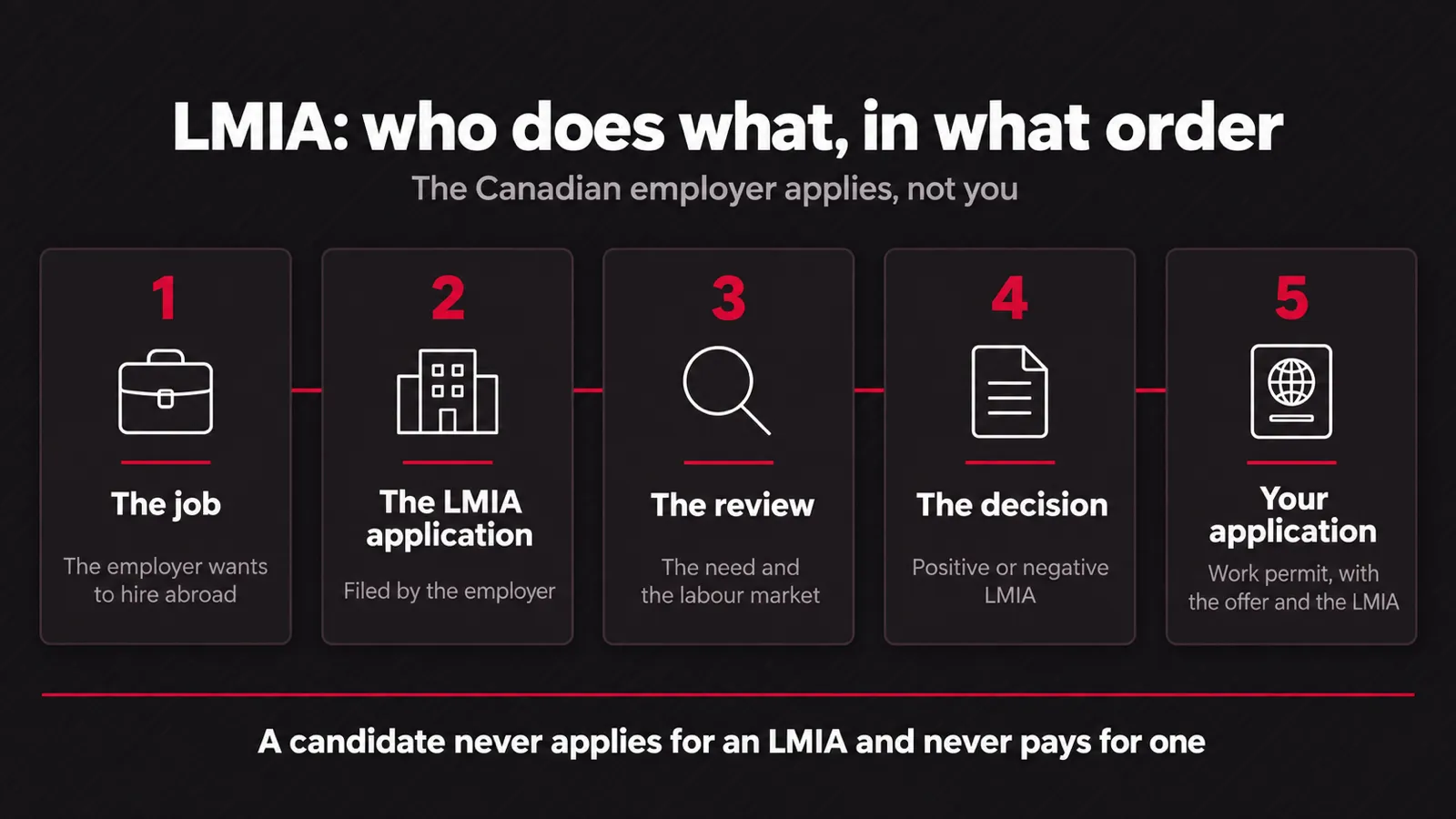
This is the employer’s step, not yours
A candidate cannot apply for an LMIA, cannot speed it up and cannot buy one. The application is made by the Canadian employer who wants to hire you, from its own account, with its own documents: the job description, the wage offered, the recruitment it carried out in Canada.
In practice, until the employer has its decision, your work permit file does not yet exist. That is the main thing to understand: on this route, the first wait is not on your side.
- The employer prepares and files the LMIA application; the candidate has no access to it
- The official fees tied to that application can never be charged to the candidate
- The employer answers questions from Employment and Social Development Canada about the role and its recruitment
- The candidate only acts afterwards, with their own work permit application
Positive or negative: what does the candidate receive?
If the decision is positive, the employer receives a positive LMIA with a number. It then gives you what you need for your own application: a job offer letter, a contract, a copy of the LMIA and the LMIA number. Keep them — these are the central pieces of your file.
If the decision is negative, no LMIA is issued and the employer cannot hire you on that basis. It may be able to revisit the role, the conditions or its recruitment and apply again, or look at another route. It is not about you personally: the decision is about the Canadian labour market.
- A job offer letter from the Canadian employer
- An employment contract
- A copy of the LMIA
- The LMIA number
The streams, in plain words
The Temporary Foreign Worker Program is divided into streams. The employer picks the one that matches the role, and each stream has its own rules, its own recruitment requirements and sometimes its own restrictions. You do not have to choose: that is the employer’s responsibility.
The names are still worth knowing, if only to follow what an employer says in an interview. The conditions of each stream are published on the official Government of Canada website.
- High and low-wage positions: most hires, split according to the wage offered against the province or territory's wage threshold, published by ESDC
- Primary agriculture positions: farm sector jobs, with their own rules
- Applications to support permanent residency: an LMIA used to support a permanent residence application
- Global Talent Stream: profiles with unique skills or skills in high demand
- Caregiver positions: child care, care for seniors or for people with medical needs
- Foreign academic positions: foreign academics at post-secondary institutions
- Hiring in the province of Quebec: Quebec has its own joint process with ESDC, and its Quebec Acceptance Certificate (CAQ) where it applies
- Recognized Employer Pilot: a stream open to employers who meet the conditions set by ESDC

When an offer needs no LMIA
Not every Canadian offer goes through an LMIA. The International Mobility Program sets out LMIA-exempt situations: the employer then submits its offer of employment to IRCC through the Employer Portal under an exemption code, and gives you an offer of employment number instead of a copy of an LMIA.
The exemption most useful to Moroccan candidates is Francophone Mobility, code C-16, for a role located outside Quebec. Our dedicated guide explains that route in detail.
What the candidate does next
A positive LMIA is not a work permit, and it does not yet allow you to work in Canada. IRCC then requires a separate employer-specific work permit application, made by the candidate, with the LMIA number, the copy of the LMIA, the job offer and the contract.
The rest of the file is that of any work permit applied for from Morocco: passport, civil-status documents, diplomas, employment letters, translations, biometrics, and any further documents IRCC may request. Official fees and current processing times are published on the IRCC website.
Red flags: nobody sells an LMIA
This is the most widespread fraud aimed at Moroccan candidates: an intermediary offers, for a payment, an LMIA or a Canadian job offer. An LMIA belongs to one employer’s application for one real job; it is not transferable, not negotiable and not for sale.
If someone asks you for money to get you an LMIA or a job, stop there and have what you are being offered checked before you pay anything.
- "I can get you an LMIA": impossible. Only a Canadian employer can apply, for its own role
- "Buy the job offer and the employer will follow": a job that is for sale is not a job
- An LMIA or a contract sent to you without ever having interviewed with the employer
- A payment demanded urgently, in cash or by transfer to a private individual
- A document shown to you on a screen but never handed over as a copy, or whose number cannot be checked
What NorthBridge Talent does, and does not do
NorthBridge Talent is a recruitment agency based in Casablanca. We connect Moroccan candidates with verified Canadian employers and prepare work-permit and visa files alongside specialised partners.
We never file LMIA applications: that step belongs to the employer. We never file immigration applications and never give immigration legal advice: that work is carried out by partner Canadian and British immigration experts, including regulated consultants (RCIC) for Canada. If you want paid help preparing your documents, you receive a written quote before any commitment. No payment is asked before this quote.
Frequently asked questions
What exactly is an LMIA?
It is a Labour Market Impact Assessment, a document an employer in Canada may need to get before hiring a foreign worker. A positive LMIA shows there is a need for a foreign worker to fill the job and that no Canadian worker or permanent resident is available to do it. The application goes to Employment and Social Development Canada.
Can I apply for an LMIA myself?
No. The LMIA is the Canadian employer’s application, filed from its own account with its own documents about the role, the wage and its recruitment in Canada. A candidate can neither apply for one, nor speed it up, nor buy one. Your own step comes afterwards, with the work permit application made to IRCC.
What does the employer give me if the LMIA is positive?
IRCC states that to apply for your work permit you need a job offer letter, a contract, a copy of the LMIA and the LMIA number. The employer passes those to you after the positive decision. Keep them: they are the central pieces of your work permit file.
What happens if the LMIA is refused?
If the decision is negative, no LMIA is issued and the employer cannot hire you on that basis. It may revisit the role, the conditions or its recruitment and apply again, or look at another route. The decision is about the Canadian labour market and about the job, not about your personal background.
Does every Canadian job offer need an LMIA?
No. The International Mobility Program sets out LMIA-exempt situations. The employer then submits its offer of employment to IRCC through the Employer Portal under an exemption code, and gives you an offer of employment number instead of a copy of an LMIA. Francophone Mobility, code C-16, is the example most useful to Moroccan candidates.
Does a positive LMIA let me work in Canada?
No. The LMIA concerns the employer; it does not authorise you to work. You then have to make your own application to IRCC for an employer-specific work permit, with the LMIA number, the copy of the LMIA, the job offer and the contract, then the rest of the file: passport, diplomas, translations and biometrics.
Can an LMIA or a job offer be bought?
No, and any such proposal is a red flag. An LMIA belongs to one employer’s application for one real job: it is not transferable and not for sale. If an intermediary asks you for money to get you an LMIA or a job, have what you are being offered checked before you pay anything.
LET’S TALK ABOUT YOUR PLANS
An adviser answers you, in Casablanca or remotely
Ask your question, have your file reviewed or book a consultation. You receive a written quote before any payment.
Monday to Friday, 9 am to 5 pm