
GUIDE · US VISA
US visa interview questions (B1/B2): preparing from Morocco
At a B1/B2 visitor visa interview, the consular officer asks short questions about why you are travelling, your ties to Morocco, who pays for the trip and your travel history. The officer wants honest answers that match your DS-160 form and documents. Preparing means knowing your own file, not reciting a script.
Updated
How the interview works at the Casablanca consulate
In Morocco, nonimmigrant visa applications, including the B1/B2 visitor visa for business and tourism, are handled by the US Consulate General in Casablanca. You book the appointment online after completing the DS-160 form, through the official scheduling site linked from the US Embassy in Morocco website. Fees, appointment wait times and the exact document list change, so always check the current figures and instructions on travel.state.gov and on the US Embassy in Morocco website.
The interview itself is short. You stand at a window facing an officer who already has your DS-160 on screen. The officer asks a few direct questions and often decides on the spot. US law starts from a simple presumption: a visitor visa applicant is presumed to intend to immigrate until they satisfy the officer otherwise. Every question is testing the same thing. Is your trip temporary, with a clear purpose, and will you return to Morocco?
Nobody can predict the decision, which belongs solely to the consular officer. What you control is how clear and consistent your answers are.
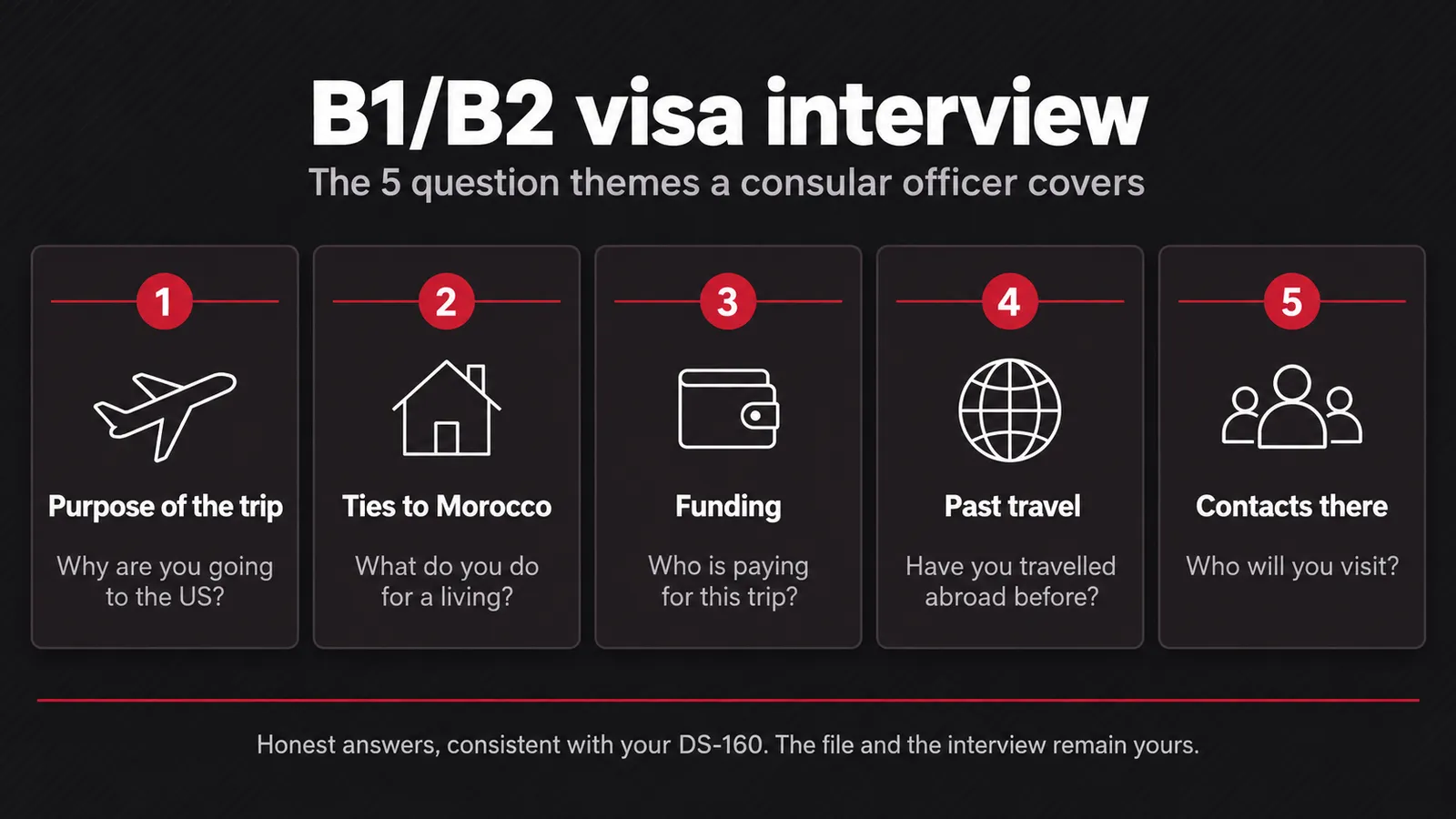
Questions about the purpose and plan of your trip
These almost always come first. The officer wants to know why you are going, for how long, and whether the plan matches what you declared on the DS-160. The most common forms of the question are:
- Why do you want to go to the United States?
- How long will you stay, and when are you coming back?
- Where will you stay? Which city?
- Who are you visiting? How do you know them?
- For business: which company, trade show or meeting? Who invited you?
- Have you booked your flight or accommodation yet?
Questions about your ties, finances and travel history
Next come the questions about your life in Morocco. They are not traps. They show the officer what brings you back, whether that is your job, family, studies, business or property.
- What do you do for a living? How long have you worked for this employer?
- Are you married? Do you have children? Are they travelling with you?
- Who is paying for this trip? How much do you expect to spend?
- What is your monthly income?
- Have you travelled abroad before? Where?
- Do you have family in the United States?
- Have you ever been refused a visa, for the US or any other country?
How to prepare honest, consistent answers
The golden rule is that every answer must match your DS-160 and your documents. Reread your form before the interview. If you wrote two weeks with a cousin in New York, do not talk about a month in Florida. A contradiction, even an innocent one, weighs more than a modest situation explained clearly.
Answer the question you were asked in one or two sentences, then stop. The officer will follow up if they want more. Long prepared speeches sound rehearsed and make you lose the thread. Talk about your real situation with specific facts: your job title, how long you have held it, your return date, the person hosting you.
If you do not know an answer, say so. Never invent anything, and never present a document you cannot stand behind. Misrepresentation can affect your future applications for a long time. Finally, practise out loud in the language of the interview. It is the best way to stay calm on the day.
Which documents to bring on interview day
The official, current list is on the scheduling site and on travel.state.gov, so check it before you go. In practice there are two groups: documents required to be admitted to the interview, and documents that support your situation if the officer asks. The officer may not look at anything, because your answers come first. But an organised folder lets you find any page in seconds.
- Your valid passport, plus any old passports you have
- Your DS-160 confirmation page
- Your appointment confirmation and proof of fee payment
- A photo meeting the requirements, if one is requested
- Employment letter, payslips or business documents (such as your commercial register extract)
- Recent bank statements
- For business trips: the company invitation or trade show registration
- For family visits: the contact details and status of the person hosting you
Common mistakes to avoid
Many difficult interviews come down to a handful of recurring mistakes. None of them is about your English or how eloquent you are. Nearly all of them are about preparation.
A useful test before the day: ask someone you trust to put the questions above to you in a random order, then check each answer against your DS-160. Wherever you hesitate or contradict the form, that is where to work. The aim is not to sound perfect, but to be able to explain your own situation simply and truthfully.
- Reciting memorised answers that do not sound like your own
- Answers that contradict the DS-160 (dates, address, employer, who pays)
- A vague purpose: "visiting", with no city, no length of stay, nobody on the other end
- Letting someone else fill in the DS-160 without checking it. You are the one who signs it
- Bringing an unsorted pile of papers, or documents you do not know the contents of
- Hiding a previous refusal or an earlier stay in the US
- Believing an intermediary who promises a visa. Nobody can
What NorthBridge Talent does, and what we do not do
NorthBridge Talent prepares your US visitor visa file with you. We review your reason for travelling and your situation, build a personalised document list, check that your DS-160 and your documents are consistent, and run mock consular interviews with honest feedback after each one. The file and the interview remain yours: we prepare, you answer.
We do not fill in the form for you, we do not script your answers, we do not give legal advice and we promise no outcome. The decision belongs solely to the US consulate. The price of our support is set out in a written quote before you commit to anything. No payment is asked before this quote.
Our US visitor visa serviceBook an appointmentE-2 visa for Moroccans
Frequently asked questions
What are the most common US visa interview questions?
Consular officers mostly ask why you are travelling, how long you will stay, where you will stay, who is paying, what you do in Morocco, whether you have family in the United States, and whether you have travelled before or been refused a visa. All of these questions check that your trip is temporary and that you will return to Morocco.
Where is the US visitor visa interview held in Morocco?
In Morocco, nonimmigrant visa interviews, including the B1/B2 visitor visa, take place at the US Consulate General in Casablanca. You book the appointment online after completing the DS-160 form, through the official scheduling site linked from the US Embassy in Morocco website. Check the current address and instructions before you travel there.
How long does a US visa interview last?
The interview is usually short: a few direct questions at a window, with an officer who has already read your DS-160. Its length tells you nothing in particular about the decision. What matters is answering each question clearly and consistently with your form and your documents, without reciting a prepared script.
Should I bring bank statements to the interview?
It is sensible to bring recent bank statements, along with your employment letter and other documents about your situation, even though the officer does not always ask for them. The documents required to be admitted, such as your passport and DS-160 confirmation, are listed on the scheduling site and on travel.state.gov.
Can I prepare my answers in advance?
Yes, as long as you prepare the substance rather than a script. Reread your DS-160, gather the specific facts of your situation and practise answering out loud, briefly. A memorised answer is easy to spot; an honest answer that matches your file is the best preparation there is.
What happens if my US visa is refused?
A refusal under section 214(b) means the officer was not convinced that your trip is temporary; it does not stop you from applying again later, and a new application is assessed afresh. A refusal under section 221(g) means a document is missing or administrative processing is needed. In both cases, follow the explanations published on travel.state.gov and the instructions the consulate gives you.
Can NorthBridge Talent promise me a US visa?
No. Nobody can promise a visa: the decision belongs solely to the US consulate. NorthBridge Talent prepares the file and the interview with you through mock interviews, but the file and the interview remain yours. We do not fill in the form for you and we do not give legal advice.
LET’S TALK ABOUT YOUR PLANS
An adviser answers you, in Casablanca or remotely
Ask your question, have your file reviewed or book a consultation. You receive a written quote before any payment.
Monday to Friday, 9 am to 5 pm