
Document checklist and steps of the file
Canadian work permit documents and timelines from Morocco
An employer-specific work permit rests on a Canadian job offer, a valid passport, your diplomas and employment letters, your biometrics and, if IRCC asks, a police certificate and a medical exam. Processing times vary by country and stream: current times are published on the official IRCC website.
Updated

What does an employer-specific work permit file contain?
Everything starts with the job offer. Depending on the role, the Canadian employer obtains a Labour Market Impact Assessment (LMIA), or submits an LMIA-exempt offer under the International Mobility Program and gives you an offer of employment number. Without this piece from the employer, the application cannot move forward.
The rest of the file proves your identity and your ability to do the job. The exact list depends on the stream and your situation: always confirm it against the document checklist shown on the official IRCC website at the time you apply.
- The employer's offer: a copy of the LMIA and the employment contract, or the offer of employment number for an exempt offer
- A valid passport and photos that meet IRCC specifications
- Identity and civil-status documents (electronic national ID card – CNIE, birth certificate, marriage certificate if your spouse comes with you)
- Your diplomas, training certificates and employment letters from past employers
- An up-to-date CV that matches your employment letters
- Proof of language ability where the role or stream requires it
- A police certificate if IRCC asks for one: the fiche anthropométrique for Moroccan citizens, the bulletin n° 3 for foreign nationals living in Morocco
- A medical exam with an IRCC panel physician, if IRCC asks for one
- Your biometrics (fingerprints and photo), required for a work permit application unless you have already given biometrics that are still valid
- A Quebec Acceptance Certificate (CAQ), issued by the Government of Québec, if the job is in Quebec and goes through an LMIA, unless exempt
Do my documents need to be translated?
Yes. Any document that is in neither English nor French — a birth certificate or employment letter written in Arabic, for example — must come with an English or French translation. If the translator is not a certified translator, IRCC also asks for an affidavit from the person who did the translation.
IRCC states that translations cannot be done by the applicant or by a member of their family. IRCC also asks for a copy of the original document to be included with its translation. Some Moroccan documents are already written in French, such as the fiche anthropométrique, issued in French and Arabic: check before paying for a translation.
What are the steps, in order?
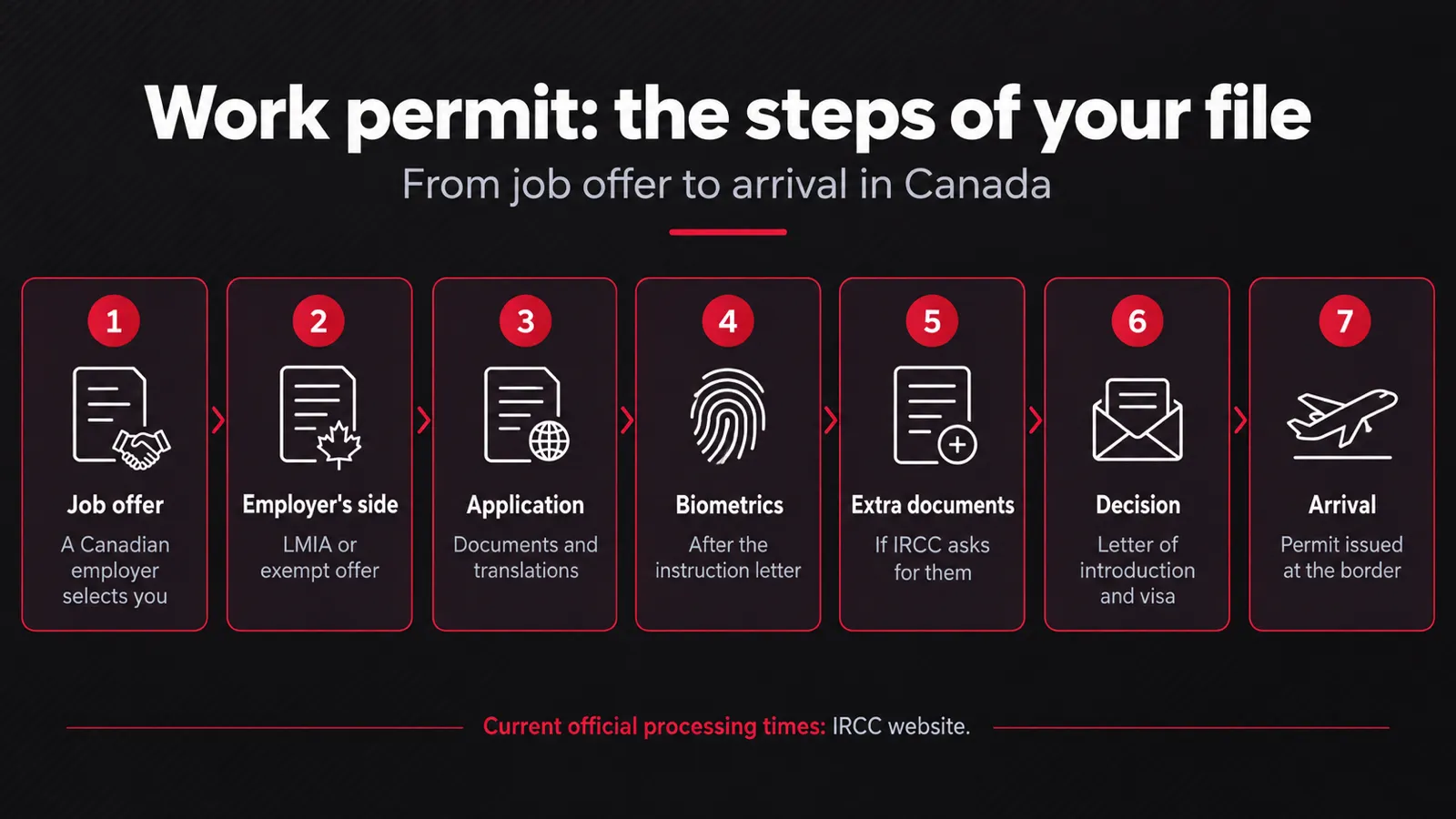
Each step depends on the one before it. IRCC's document checklist shows what to include when you apply, and IRCC may ask for more during processing.
Morocco is among the countries whose citizens generally need a visa to travel to Canada. IRCC states that no separate application is needed: if a work permit application made from outside Canada is approved, the temporary resident visa (or electronic travel authorization, as the case may be) is issued automatically.
- The job offer: a Canadian employer selects you for a role
- The employer's side: an LMIA obtained by the employer, or an LMIA-exempt offer submitted by the employer
- The work permit application, with the documents and the official fees
- Biometrics, after you receive the instruction letter from IRCC
- A possible request for more documents, a medical exam or a police certificate
- IRCC's decision: if approved, a port of entry letter of introduction and, for Moroccan citizens, the temporary resident visa (or electronic travel authorization, as the case may be)
- Travel: at the Canadian port of entry, on presentation of the letter of introduction, the border services officer decides on admission and issues the work permit itself
What makes a file slower?
Several avoidable causes of delay lie in the file itself. IRCC states that an incomplete application can be returned without being processed, and the time lost is added to everything else.
- A missing, expired or unreadable document
- A missing or non-compliant translation
- A biometrics appointment booked long after receiving the instruction letter
- A slow reply to a request for more documents
- Dates or job titles that do not match between the CV and the employment letters
- A medical exam or police certificate requested during processing
Where can I check official processing times?
Processing times change regularly and depend on the country you apply from and the type of permit. The reference source is IRCC's processing times tool on its official website, where you select a work permit applied for from outside Canada and your country of residence.
That official time covers only IRCC's processing of the application. It does not include recruitment, the employer's steps or the preparation of your documents. Be wary of anyone who promises you a set timeline: no intermediary controls IRCC's processing.

Common mistakes to avoid
Here are common mistakes that a careful review before submitting can catch.
- Translating your own documents, or having a relative translate them
- Providing employment letters with no letterhead, no stamp or no description of duties
- Letting your passport approach its expiry date during the process
- Providing the wrong police certificate: for a Moroccan citizen, IRCC asks for the fiche anthropométrique and does not accept the bulletin n° 3 issued by the court
- Paying an intermediary who promises a permit without a real job offer from a Canadian employer
What NorthBridge Talent does, and does not do
NorthBridge Talent is a recruitment agency based in Casablanca. We connect Moroccan candidates with verified Canadian employers and prepare work-permit and visa files alongside specialised partners.
We never file immigration applications and never give immigration legal advice: that work is carried out by partner Canadian and British immigration experts, including regulated consultants (RCIC) for Canada. If you want paid help preparing your documents, you receive a written quote before any commitment. No payment is asked before this quote.
Frequently asked questions
What documents do I need for a Canadian work permit from Morocco?
The central piece comes from the employer: the LMIA and contract, or an offer of employment number for an exempt offer. You add a valid passport, photos, civil-status documents, diplomas, employment letters and a CV. A police certificate, a medical exam and language proof may be requested depending on the role. Biometrics are required unless you have already given biometrics that are still valid.
Do my documents in Arabic need to be translated?
Yes. Any document in neither English nor French must come with a translation into one of those two languages. If the translator is not certified, IRCC asks for an affidavit from the translator. The translation cannot be done by you or by a member of your family.
How long does a Canadian work permit take from Morocco?
It depends on the stream, your country of residence and IRCC's workload at the time you apply. Current processing times are published in IRCC's processing times tool, on the official IRCC website. They do not include recruitment, the employer's steps or the preparation of your documents.
Is a police certificate always required?
Not necessarily when you apply: IRCC may ask for one depending on the file, and its checklist and instructions show whether to include it. For Morocco, IRCC asks Moroccan citizens for the fiche anthropométrique and foreign nationals for the bulletin n° 3. A bulletin n° 3 issued by a court is not accepted for a Moroccan citizen.
What can delay my file?
Several causes lie in the file itself: a missing or expired document, a non-compliant translation, biometrics done late, a slow reply to a request for more documents, or inconsistencies between your CV and your employment letters. IRCC can return an incomplete application without processing it.
Do I need to apply for a visa separately from the work permit?
No. Moroccan citizens generally need a visa to travel to Canada, but IRCC states that no separate application is needed: if a work permit application made from outside Canada is approved, the temporary resident visa (or electronic travel authorization, as the case may be) is issued automatically, at the same time as the port of entry letter of introduction.
Does NorthBridge Talent file my work permit application?
No. NorthBridge Talent is a recruitment agency: it connects candidates with verified Canadian employers and prepares files alongside specialised partners. Filing and any immigration legal advice are handled by partner Canadian and British immigration experts.
LET’S TALK ABOUT YOUR PLANS
An adviser answers you, in Casablanca or remotely
Ask your question, have your file reviewed or book a consultation. You receive a written quote before any payment.
Monday to Friday, 9 am to 5 pm