
An LMIA-exempt work permit
Francophone Mobility (C-16): working in Canada without an LMIA, from Morocco
Francophone Mobility, designated by LMIA exemption code C-16, is a work permit category exempt from the Labour Market Impact Assessment (LMIA), under the International Mobility Program. It is for French-speaking workers hired by a Canadian employer located outside Quebec. The employer starts the process by submitting its offer of employment to IRCC.
Updated

What is Francophone Mobility (C-16)?
Most employer-specific Canadian work permits require the employer to first obtain a Labour Market Impact Assessment (LMIA) from Employment and Social Development Canada. The International Mobility Program (IMP) sets out exceptions: situations that fall under Canadian interests, and no LMIA is asked for. Each exception carries an exemption code.
Francophone Mobility is exemption code C-16. It covers the hiring of French-speaking workers by Canadian employers located outside Quebec, in one of the nine other provinces or three territories. The role must be classified under the National Occupational Classification (NOC): every Training, Education, Experience and Responsibilities (TEER) category is covered, except primary agriculture occupations in TEER 4 and 5. Current conditions are published on the official IRCC website.
It is an LMIA exemption, not a work permit exemption. The work permit application still has to be made, with its documents, official fees and processing times, all published on the IRCC website.
Who is this stream for?
The stream was designed for French-speaking workers settling in Francophone and Acadian communities outside Quebec. For a Moroccan candidate it is often the route with the fewest steps for the employer: French is already a working language, and the Canadian employer does not have to go through an LMIA.
It is not an open program you apply to on your own. The starting point is a real job offer from a Canadian employer willing to do its part of the process.
- You speak French and you are aiming at a role located outside Quebec
- A Canadian employer has selected you for a role classified in the NOC, other than a primary agriculture occupation in TEER 4 and 5
- That employer is ready to submit its offer of employment to IRCC; the employer compliance fee is paid to IRCC
- You can show your French ability against IRCC's criteria
- You meet the general work permit requirements: a valid passport, admissibility, biometrics
What the Canadian employer must do
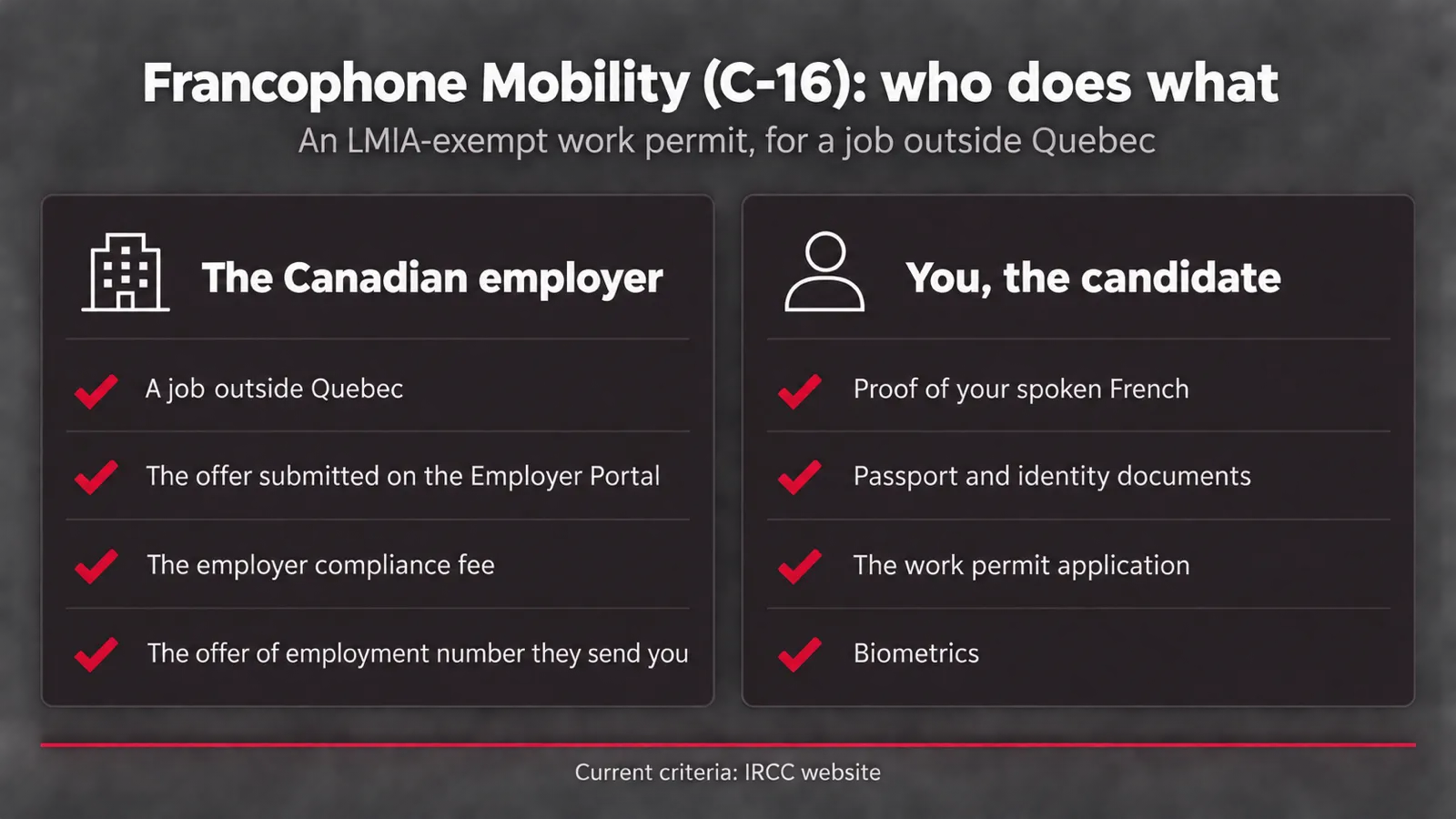
The process starts with the employer, and nothing can move before it. The employer signs in to IRCC's Employer Portal and submits its offer of employment there, quoting the LMIA exemption code IRCC writes as C16 (Mobilité Francophone), often written C-16. At this stage, the employer compliance fee is paid to IRCC. The amount of that fee is set by IRCC and published on its official website.
Once the offer is submitted, IRCC issues an offer of employment number. The employer gives you that number and a copy of the signed offer: without the number, your work permit application cannot be made under this stream.
- Create or use its account in IRCC's Employer Portal
- Submit the offer of employment under exemption code C16 (Mobilité Francophone)
- The employer compliance fee is paid to IRCC
- Give the candidate the offer of employment number and the signed offer
What the candidate must do
Your application only comes after the employer step. You apply for an employer-specific work permit with an LMIA exemption, quoting the offer of employment number your employer gave you. The checklist IRCC shows you when you apply is what counts: it is personalised to your situation.
As with any work permit applied for from outside Canada, biometrics are required unless you have already given biometrics that are still valid. Our documents guide sets out what a Canadian work permit file contains from Morocco, translations included.
- The offer of employment number received from the employer
- A valid passport and photos that meet IRCC specifications
- Proof of your French ability, in a form IRCC accepts for this stream
- The employer-specific, LMIA-exempt work permit application, with the official fees
- Biometrics, after you receive the instruction letter from IRCC
- Any further documents IRCC may request during processing

How is the French level assessed?
IRCC assesses spoken French — listening and speaking — against the Niveaux de compétence linguistique canadiens (NCLC), the French-language counterpart of the Canadian Language Benchmarks. The minimum level required for this stream is set by IRCC and published on its official website: check it before doing anything, and be wary of any intermediary who quotes you a threshold without showing you the official page.
For this stream IRCC accepts speaking and listening results from the Test d'évaluation de français (TEF) or the Test de connaissance du français (TCF); the version of the test it accepts is set out on the official IRCC website. IRCC also states that it accepts other evidence of French ability, for example written confirmation from a college or university of a program taken in French, or other documents showing education in French. IRCC further states that you do not need to prove you can read or write in French to qualify for this exemption.
Many Moroccan candidates were educated in French. IRCC states that it accepts such evidence of education for this exemption; what applies in your own situation is set out in its instructions.
A temporary permit, not permanent residence
The permit issued under Francophone Mobility is a temporary work permit, tied to the employer named in the offer of employment. Its length and conditions are written on the permit itself. It is not permanent residence, and it does not turn into permanent residence automatically.
That said, French-speaking workers in Canada often look afterwards at other programs: Express Entry and its draws, or the Provincial Nominee Programs. Each has its own criteria, set by IRCC or by the province, and the outcome rests with IRCC or the province, not with an intermediary. Our comparison guide explains how those routes differ from Francophone Mobility.
The most common misunderstandings
Many of the questions we get in Casablanca come back to the same confusions. Here they are, corrected.
- "C-16 is a visa I apply for on my own": no. It is an LMIA exemption code. The process starts with the offer of employment the employer submits through the Employer Portal.
- "No LMIA means no file": no. The exemption covers the Labour Market Impact Assessment, not the work permit application, which still has to be made in full.
- "It works anywhere in Canada": no. Quebec is excluded from this stream. A role in Quebec falls under different rules, including the Quebec Acceptance Certificate where it applies.
- "I have to sit a written French exam": not necessarily. IRCC assesses spoken French, and accepts evidence other than a test in some cases.
- "An intermediary can get me a C-16": no. Without a real Canadian employer submitting an offer, there is no file. Any paid offer of a "C-16 permit with no employer" is a warning sign.
What NorthBridge Talent does, and does not do
NorthBridge Talent is a recruitment agency based in Casablanca. We connect Moroccan candidates with verified Canadian employers and prepare work-permit and visa files alongside specialised partners.
We never file immigration applications and never give immigration legal advice: that work is carried out by partner Canadian and British immigration experts, including regulated consultants (RCIC) for Canada. If you want paid help preparing your documents, you receive a written quote before any commitment. No payment is asked before this quote.
Frequently asked questions
What is the Francophone Mobility (C-16) work permit?
It is a work permit category exempt from the Labour Market Impact Assessment, set out under the International Mobility Program as exemption code C-16. It lets a Canadian employer located outside Quebec hire a French-speaking worker without obtaining an LMIA, where the conditions set by IRCC are met. The work permit application itself still has to be made.
Can I apply for a C-16 permit without an employer?
No. The process starts with the employer: it submits its offer of employment to IRCC through the Employer Portal under exemption code C-16, then gives you the offer of employment number. The employer compliance fee is paid to IRCC. Without that number, the work permit application cannot be made under this stream.
Does Francophone Mobility work in Quebec?
No. This stream covers roles located outside Quebec, in one of the nine other provinces or three territories. A role in Quebec falls under different rules, including the Labour Market Impact Assessment and the Quebec Acceptance Certificate where they apply. Current conditions are published on the official IRCC website.
What French level is needed, and which test?
IRCC assesses spoken French against the Niveaux de compétence linguistique canadiens (NCLC) and sets the minimum level for this stream itself, published on its official website. Speaking and listening results from the Test d'évaluation de français (TEF) and the Test de connaissance du français (TCF) are accepted. IRCC also states it accepts other evidence of education in French, and does not require proof of reading or writing for this exemption.
Does Francophone Mobility lead to permanent residence?
No. The permit issued under this stream is a temporary work permit, tied to the employer named in the offer. It does not turn into permanent residence automatically. Some French-speaking workers then look at other programs, such as Express Entry or the Provincial Nominee Programs, each with its own criteria, decided by IRCC or by the province.
Do I still have to give biometrics?
Yes. Biometrics are required for a work permit application made from outside Canada, unless you have already given biometrics that are still valid. You give them after receiving the instruction letter from IRCC. The LMIA exemption changes nothing about that step, or about the rest of the file.
Does NorthBridge Talent file my C-16 application?
No. NorthBridge Talent is a recruitment agency: it connects candidates with verified Canadian employers and prepares files alongside specialised partners. Filing and any immigration legal advice are handled by partner Canadian and British immigration experts, including regulated consultants (RCIC) for Canada.
LET’S TALK ABOUT YOUR PLANS
An adviser answers you, in Casablanca or remotely
Ask your question, have your file reviewed or book a consultation. You receive a written quote before any payment.
Monday to Friday, 9 am to 5 pm