
Family sponsorship
Canada family sponsorship from Morocco: who can sponsor whom
Canadian family sponsorship does not work the way many people expect: a Canadian citizen or permanent resident sponsors a relative, not the other way round. Someone in Morocco cannot open a sponsorship file alone. This page explains who may sponsor, who may be sponsored, and what the sponsor actually commits to.
Updated

Who can sponsor a relative
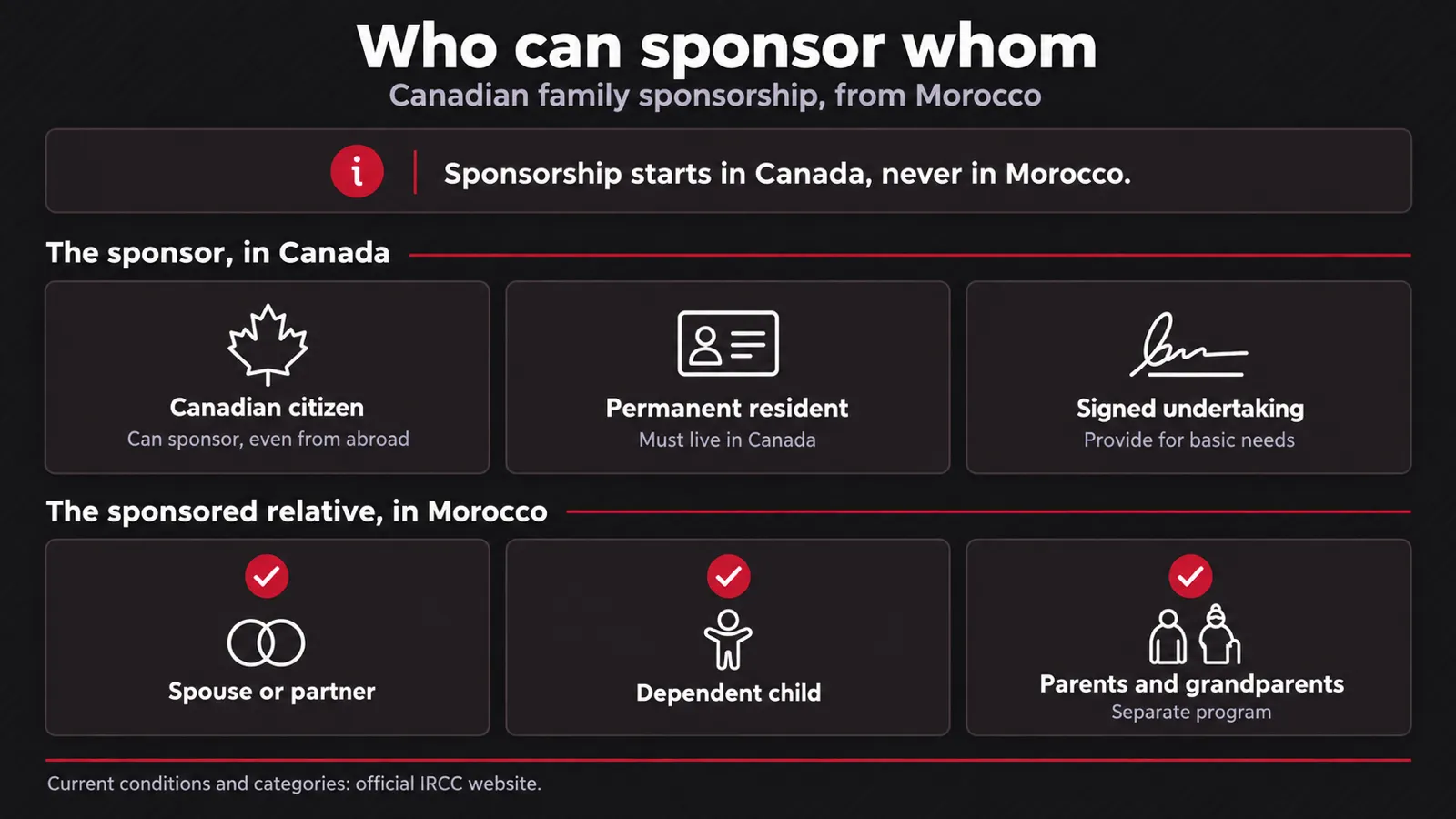
Sponsorship always starts in Canada. The sponsor must be a Canadian citizen, a permanent resident of Canada, or a person registered in Canada under the Indian Act, and must meet the minimum age set by IRCC. The sponsor files the sponsorship application; the relative in Morocco files their own permanent residence application alongside it.
One point is widely misunderstood and worth reading twice: a permanent resident living outside Canada cannot sponsor. A Canadian citizen living abroad may sponsor a spouse, partner or dependent child, but must show they plan to live in Canada by the time the sponsored person becomes a permanent resident.
- Be a Canadian citizen, a permanent resident, or registered under the Indian Act
- Meet the minimum age set by IRCC
- Sign an undertaking and a sponsorship agreement
- Meet the other requirements of Canadian immigration law
Who can be sponsored from Morocco
The categories are set by IRCC and are not negotiable. The most common route from Morocco covers a spouse, a partner and dependent children. Other categories exist, each with its own conditions.
"Common-law partner" and "conjugal partner" are precise statuses in Canadian law, not general descriptions: each has an official definition published by IRCC. A relationship that does not match one of those definitions does not open a sponsorship route, however genuine and long-standing it is.
- A spouse, common-law partner or conjugal partner
- Dependent children, as IRCC defines them
- An adopted child, under a separate process
- Parents and grandparents, through a separate program (see below)
- Certain other relatives, in limited situations
The undertaking: what the sponsor really accepts
Sponsoring is not a letter of support. The sponsor signs an undertaking with the Canadian government, agreeing to provide for the sponsored person’s basic needs for a period set in the regulations, so that they do not need social assistance.
That undertaking holds even if circumstances change — separation, divorce, a move, financial trouble. This is why IRCC examines the sponsor’s situation before accepting the application, and it is the part families most often underestimate.
Is there an income requirement?
For a spouse, partner or dependent child, IRCC states that in most cases there is no income requirement. That is a real difference from other immigration routes, and it often comes as a surprise.
There are exceptions, notably where the sponsored dependent child has dependent children of their own. In those cases a minimum income applies and is shown through the financial evaluation form IRCC provides. The parents and grandparents program carries an income requirement of its own. The thresholds and forms are published on the official IRCC website — check them at the source, they change.

If the family settles in Quebec
Quebec applies its own sponsorship conditions and its own undertaking, signed with the Government of Quebec in addition to the federal steps. A family settling in Quebec therefore faces two sets of requirements, not one.
Order matters: IRCC asks you to wait for its confirmation before filing the undertaking with Quebec. An application sent to Quebec too early is not processed. This is a common scheduling mistake, and it costs months.
Parents and grandparents: where the program stands
Sponsoring parents and grandparents does not work like spousal sponsorship. It runs through an interest-to-sponsor form and then an invitation to apply — you cannot simply file whenever you choose.
As at the update date of this page, IRCC states that it is not accepting new interest-to-sponsor forms and not inviting new sponsors, until further notice; applications already filed continue to be processed. This can change: the status of the program should be checked on the official IRCC website on the day you read it.
IRCC also points to the super visa as another option for parents and grandparents who want to stay with family in Canada. That is a visa for a stay, with its own conditions, not permanent residence.
What prevents someone from sponsoring
IRCC publishes a list of situations that make a sponsor ineligible. Most of them concern past commitments that were not met, and the sponsor’s financial or legal situation.
Some are temporary and lift with time or once the situation is put right. Others do not. Where there is any doubt, it is worth checking before assembling a full file.
- Having been sponsored as a spouse or partner recently
- Still being bound by an earlier sponsorship undertaking
- Having failed to meet a past sponsorship undertaking
- Being in default on court-ordered family support payments
- Receiving social assistance for a reason other than a disability
- Being in detention, or being subject to a removal order from Canada
Red flags: nobody sells a sponsorship
Family sponsorship attracts dishonest intermediaries, because it involves families who are in a hurry to be together. One simple rule protects against most of it: sponsorship rests on a genuine family relationship and an eligible person in Canada. It cannot be bought, and it cannot be sped up for a payment.
Be wary of anyone who promises a timeline, who offers an arranged marriage to open a file, or who asks for a substantial payment before giving you a written document setting out precisely what is provided and by whom. A marriage entered into solely to obtain status is fraud under Canadian law, with lasting consequences for both people.
What NorthBridge Talent does, and what it does not
NorthBridge Talent is a recruitment agency based in Casablanca. On family sponsorship files we help gather and organise the documents that are asked for, understand the order of the steps, and prepare for the interview where there is one. Immigration steps are handled with partner Canadian immigration experts.
We do not file the application for you and we do not give legal immigration advice. Nor can we create a family relationship or influence an IRCC decision. For paid support, you receive a written quote before any commitment. No payment is asked before this quote.
Frequently asked questions
Can I apply for family sponsorship myself from Morocco?
Not on your own. The sponsorship application is filed by a Canadian citizen or permanent resident living in Canada. The relative in Morocco files their own permanent residence application alongside it, but cannot open the file from their side. Without an eligible sponsor in Canada, there is no family sponsorship file to open.
Can a permanent resident living in Morocco sponsor their spouse?
No. According to IRCC, a permanent resident living outside Canada cannot sponsor. A Canadian citizen can sponsor a spouse, partner or dependent child from abroad, provided they show they plan to live in Canada by the time the sponsored person becomes a permanent resident.
Is a minimum income required to sponsor a spouse?
In most cases IRCC does not require a minimum income to sponsor a spouse, partner or dependent child. Exceptions exist, notably where the sponsored dependent child has dependent children of their own. The parents and grandparents program does carry its own income requirement. The thresholds are published on the official IRCC website.
Can parents be sponsored from Morocco right now?
The parents and grandparents program runs through an interest-to-sponsor form and then an invitation. As at the update date of this page, IRCC states that it is not accepting new forms and not sending new invitations, until further notice. Applications already filed continue to be processed. This can change: check the official IRCC website.
What is the sponsorship undertaking?
It is a commitment signed with the Canadian government in which the sponsor agrees to provide for the sponsored person’s basic needs for a period set in the regulations. It remains valid even after a separation, a divorce or financial difficulty. It is the part families most often underestimate.
Does Quebec have different rules?
Yes. Quebec applies its own sponsorship conditions and requires an undertaking signed with the Government of Quebec, in addition to the federal steps. Order matters: IRCC asks you to wait for its confirmation before filing the undertaking with Quebec, otherwise Quebec will not process it.
How long does a family sponsorship application take?
Processing times depend on the category, the office handling the file and how quickly you answer IRCC’s requests. They are published and updated on the official IRCC website. Be wary of any intermediary who announces a precise timeline or promises to speed up a file: nobody is in a position to commit to that.
LET’S TALK ABOUT YOUR PLANS
An adviser answers you, in Casablanca or remotely
Ask your question, have your file reviewed or book a consultation. You receive a written quote before any payment.
Monday to Friday, 9 am to 5 pm